As a parent, understanding your child’s academic progress is essential for providing the right support at home and ensuring they are on track for success. One tool that schools use to measure student learning is the NWEA MAP (Measures of Academic Progress) test. Unlike traditional standardized tests that assess students based on grade-level benchmarks, the MAP test is adaptive, meaning it adjusts the difficulty of questions based on a student’s responses. This allows for a more precise measurement of a child’s strengths, weaknesses, and overall academic growth over time.
While the nwea scores by grade level 2025 provides valuable insights, the scores can be confusing if you are unfamiliar with how they work. This guide will help you understand the key components of your child’s MAP scores, what they mean, and how you can use them to support their education.

Understanding the Key Components of MAP Scores
RIT Score (Rasch Unit Score)
One of the most important numbers in your child’s MAP report is the RIT score. Unlike traditional letter grades or percentage scores, the RIT score is a continuous scale that measures a student’s academic ability in reading, math, and language usage.
- RIT scores typically range from 100 to 300.
- Younger students usually have lower scores, while older students have higher scores.
- The RIT scale is consistent across grade levels, meaning a student’s score can be tracked over multiple years to measure progress.
A key feature of the RIT score is that it focuses on growth rather than simply indicating whether a student is on grade level. This means that even if a child is performing below their grade’s average, an increase in their RIT score over time shows they are learning and improving.
Percentile Rank
The percentile rank compares your child’s performance to that of other students in the same grade nationwide. This number helps provide context for how well your child is doing compared to their peers.
- A 50th percentile score means your child performed better than 50% of students in their grade.
- A 75th percentile score means they scored better than 75% of students.
It’s important to remember that a high or low percentile rank is not the only measure of success. If a child’s RIT score is growing steadily, that is a strong indication of academic progress, even if their percentile rank is not as high as expected.
Growth Score
One of the biggest advantages of the MAP test is its ability to track individual student growth over time. Because the test is administered multiple times a year—usually in the fall, winter, and spring—parents and teachers can see how much a child has progressed throughout the school year.
- A child’s growth score compares their current performance to their previous test results.
- If a student’s RIT score increased from 195 to 205, that indicates measurable progress.
- The report may also include expected growth norms, showing whether the student’s progress aligns with national averages.
Even if a student’s overall score is lower than their grade level, consistent growth over time is a positive sign and should be celebrated.
Goal Performance Areas
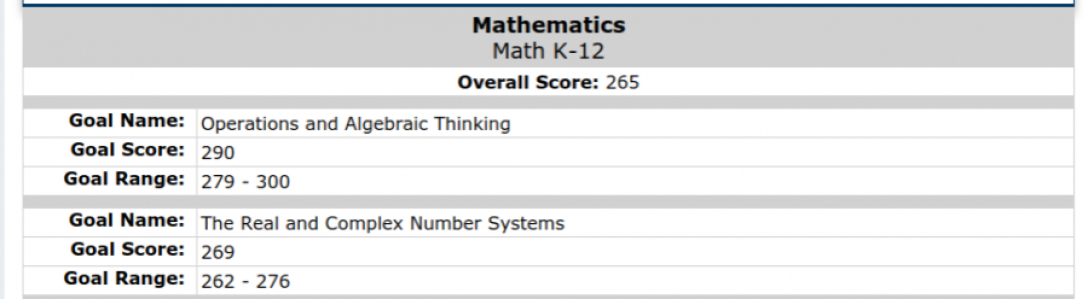
In addition to providing an overall score, the MAP test breaks down results into specific skill areas within each subject. For example:
- Reading: Informational text, literature, vocabulary
- Math: Algebraic thinking, geometry, number operations
- Language Usage: Grammar, punctuation, sentence structure
This breakdown allows parents and teachers to identify strengths and areas for improvement. If a student is excelling in algebra but struggling with geometry, targeted support can be provided to address that specific weakness.
How to Use MAP Scores to Support Your Child’s Learning
Focus on Growth Over Achievement
Many parents worry about whether their child’s score is “good” or “bad,” but the most important factor is growth. Even if your child is below the expected level, steady improvement in their RIT score means they are learning and making progress.
- If your child’s score increased significantly, celebrate their hard work.
- If their growth is slower than expected, talk to their teacher about possible interventions.
Set Realistic Academic Goals
Since the MAP test is given multiple times a year, it’s a great tool for setting short-term and long-term goals. Rather than focusing on grade-level benchmarks, use the test results to create personalized learning objectives.
- If your child scored 210 in reading in the fall, they might set a goal to reach 220 by spring.
- Focusing on steady progress rather than a single test result helps build confidence and motivation.
Identify Areas That Need Extra Support
MAP results can help pinpoint specific subjects or skills where a student needs additional help. Once you identify these areas, you can find ways to reinforce learning at home.
- For reading challenges: Encourage daily reading, discuss books together, and ask comprehension questions.
- For math difficulties: Use online math games, practice worksheets, or real-life math problems to strengthen skills.
- For writing and grammar: Have your child write short stories, keep a journal, or practice grammar exercises.
Communicate With Teachers
MAP scores provide valuable insight for parent-teacher discussions. If you have concerns about your child’s progress, schedule a meeting with their teacher and ask:
- How does my child’s MAP growth compare to expected progress?
- What are their strongest and weakest areas?
- What strategies can we use at home and in school to improve learning?
By working together, parents and teachers can create a more personalized approach to education.
Encourage a Growth Mindset
One of the most important things parents can do is help their child develop a growth mindset—the belief that intelligence and skills can improve with effort and practice.
- Praise effort and progress rather than just scores.
- Help your child understand that challenges are opportunities to learn.
- Reinforce that learning is about improving over time, not just achieving a high test score.
This mindset helps students build resilience and confidence, which are critical for long-term academic success.
Conclusion
The NWEA MAP test is a powerful tool for tracking student progress, providing detailed insights into academic strengths, weaknesses, and overall growth. By understanding key components like RIT scores, percentile ranks, and growth scores, parents can use the data to support their child’s learning journey.
Rather than focusing on a single test result, emphasize continuous improvement. Celebrate progress, address challenges, and work collaboratively with teachers to ensure your child gets the support they need. With the right approach, MAP scores can be a valuable resource for helping your child succeed in school and beyond.
 Nwea Map Test Scores 2025-2026